History
Indonesian cuisine has a long and rich history. Cooking practices are often inherited within families or passed down through generations by word of mouth. Because Indonesia is made up of many islands and diverse cultures, each region has developed its own unique flavours, ingredients, and cooking traditions.
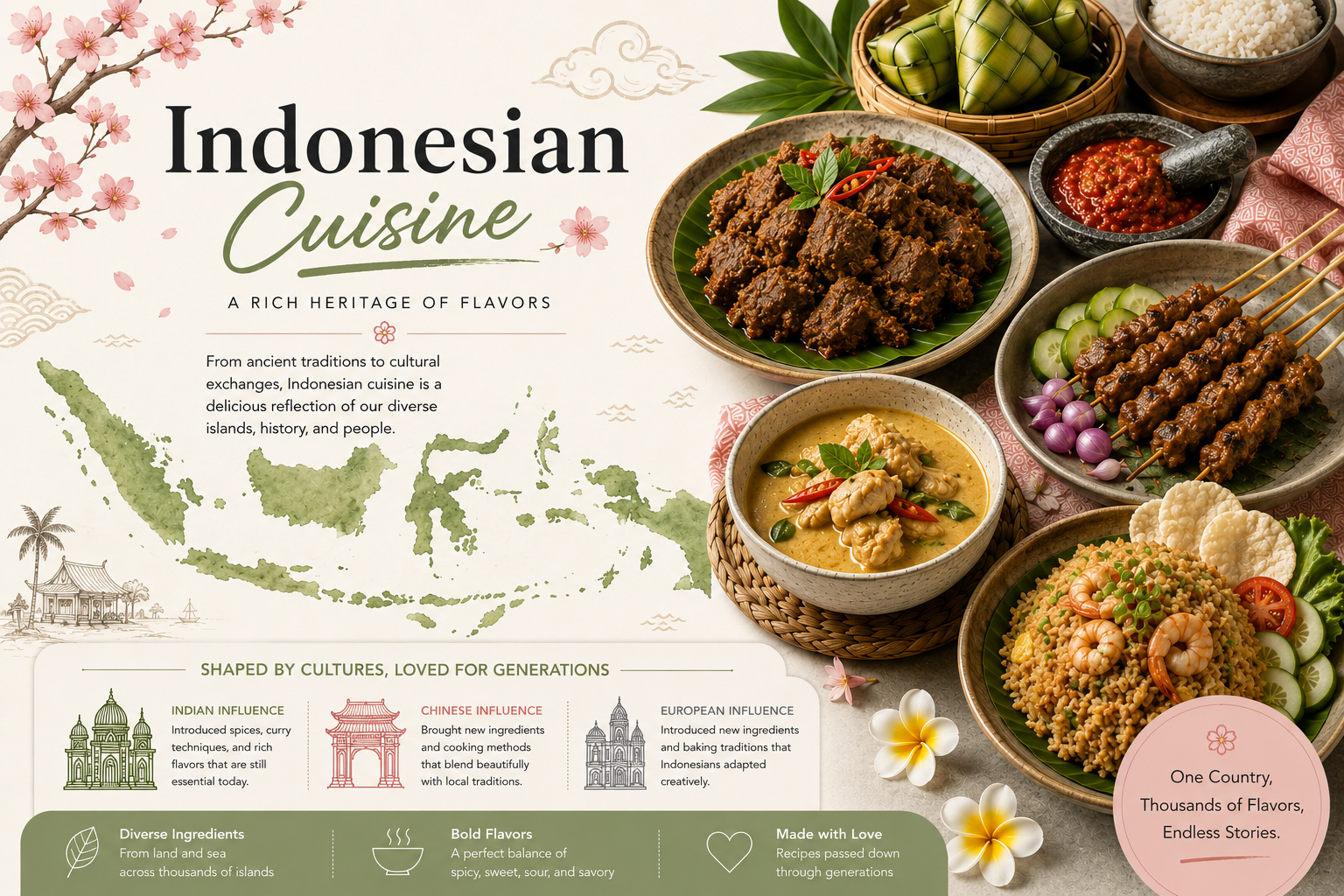
Foreign traders, migrants, and colonial influences also played an important role in shaping Indonesian cuisine. Three of the most significant influences came from Indian, Chinese, and European cultures.
Indian influence began around the 4th century, when Hinduism started to spread across parts of Indonesia. This influence can still be seen today, particularly in Sumatran and Minangkabau cuisine. Dishes such as gulai, kari, rendang, and martabak show similarities with Indian-style cooking, especially through the use of spices, curry-based sauces, and rich coconut flavours.
Chinese immigrants began arriving in Indonesia around the 7th century, with migration increasing during the Dutch colonial period. Over time, Chinese cuisine blended with local Indonesian food and also influenced neighbouring regions such as Malaysia and Singapore, where similar culinary traditions are known as Peranakan cuisine. Many popular Indonesian dishes show Chinese influence, including bakmi, bakso, bakpau, nasi goreng, mie goreng, tahu goreng, siomay, pempek, lumpia, nasi tim, cap cai, and fu yung hai.
European influence also shaped Indonesian cuisine. The Portuguese were among the first Europeans to arrive in Indonesia, bringing new ingredients and food traditions. Later, the Dutch took control of major trade routes in the 16th century in search of spices. They introduced ingredients such as cauliflower, cabbage, and turnips, as well as European-style foods such as bread, cheese, steak, and pancakes.
Indonesians adapted many European foods into local versions, including roti bakar, roti buaya, pastel tutup, bistik, and semur. Dutch influence can also be seen in Indonesian cakes and pastries, such as kue bolu, lapis legit, lapis surabaya, pandan cake, klappertaart, and kue cubit.
Popular Cuisine in Indonesia
North Sumatra, or Batak cuisine, is known for its bold and distinctive dishes. Batak food often includes pork and, in some traditional dishes, dog meat. Pig blood may also be used in certain recipes. The food is usually spicy, with a strong peppery flavour.
Another well-known cuisine from North Sumatra is Acehnese cuisine. Aceh is located in the westernmost part of Indonesia, and its food is strongly influenced by Indian and Middle Eastern traders. Many Acehnese dishes are curry-based and are known locally as kare or gulai. These dishes often use beef, goat, fish, or poultry cooked in coconut-based curry.
West Sumatra, or Minangkabau cuisine, is famous for rendang, a spicy slow-cooked beef or buffalo dish. Rendang is one of the signature dishes of Minangkabau cuisine and is well known internationally. Similar to Acehnese food, many Minangkabau dishes use coconut milk, chilli, and rich spices.
East Sumatra and Medan cuisine share similarities with Minangkabau food, but also show strong Chinese influence. This style is also related to Peranakan cuisine found in Malaysia and Singapore. Famous dishes include laksa, spicy noodles, and Nasi Medan, also known as Medanese rice.
South Sumatra cuisine is influenced by Malay, Chinese, and Javanese cultures. One of its most famous dishes is pempek, a fish cake served with cuko, a sweet, sour, and spicy sauce made from palm sugar, chilli, tamarind, and vinegar. Palembang is considered the culinary centre of South Sumatra.
West Java, or Sundanese cuisine, is known for its freshness. Sundanese food often includes fresh vegetables served as a salad, usually accompanied by sambal as a dipping sauce. The flavour is typically fresh, mild, slightly sweet, sour, savoury, and salty. Sambal terasi is one of the most popular condiments in Sundanese cuisine.
Jakarta, located in western Java, is home to Betawi cuisine. Betawi food has been influenced by many local and foreign cultures. During Dutch colonisation, Jakarta, formerly known as Batavia and Sunda Kelapa, was the centre of Dutch trading administration. As a result, Betawi cuisine reflects European, Chinese, Malay, Arab, and Indian influences.
Famous Betawi dishes include gado-gado, a mixed vegetable salad with peanut sauce; ketoprak, made with bean sprouts, tofu, rice vermicelli, rice cake, peanut sauce, and crackers; sayur asem, a sour vegetable soup; and kerak telor, a spiced omelette with dried shredded coconut.
Central Java cuisine is influenced by the ancient kingdoms of Yogyakarta and Surakarta. The dishes are generally sweet and rich in flavour. One of the most famous dishes is gudeg, a jackfruit curry usually served with fried chicken or braised chicken cooked in coconut sauce.
East Java cuisine is similar to Central Java cuisine, but it is usually less sweet and spicier. Seafood is also common. East Java food is strongly influenced by Madurese cuisine. Because Madura is one of the main salt-producing regions in Indonesia, its food is often savoury and salty. One of its most famous dishes is Madurese satay, usually served with peanut sauce.
Balinese cuisine is known for its hot, spicy, and aromatic dishes. Famous Balinese foods include bebek betutu, which is duck stuffed with spices and wrapped in banana leaves; Balinese satay; and roasted pork stuffed with hot and spicy herbs.
North Sulawesi, or Minahasan and Manadonese cuisine, is famous for its variety of meat and seafood dishes, rich spices, and hot condiments. Chinese and European influences can also be seen in Manadonese cakes and pastries. The region is also known for exotic meats, including dog, rat, monkey, bat, and other animals.
Makassar and Buginese cuisine, from South Sulawesi, is strongly connected to the sea. The Buginese people are known as expert fishermen and seafarers. Similar to Manadonese cuisine, Makassar food is famous for seafood dishes and bold flavours.